Gosh you make claim about your personal ability to purchase automatic weapon. You supply no evidence to support your claim. In fact you admit you have no experience in purchasing weapons under any circumstance. To show the contrary, I provide several examples of highly motivated purchasers who have the resources and many cases the criminal connections but have been unable to obtain the weapons. You are presented the overwhelming evidence to the contrary of your stated opinion and you reject it. That is cognitive dissonance.O-Trap;1877022 wrote:[/FONT][/COLOR]Well I'm hardly going to go get one just to prove my point. Moreover, I didn't say completely without difficulty, as though I'd trip over one walking down the sidewalk.
However, there is not evidence to the contrary, despite what you claim. I'm not going to go over your continued conflation of "cannot" and "did not" again. Nor am I going to over-explain your misappropriation of correlations as evidence for causation. I've done that enough for anyone, even you, to see. Whether you cannot or merely will not is not able to be known (see how that works?) by anyone but you.
I've not abandoned attacks on it, because I was never attacking it in the first place. Thank you for demonstrating a straw man, however. Your efforts in this thread would be an excellent example of quite a few of the logical fallacies that even a college freshman learns to avoid.
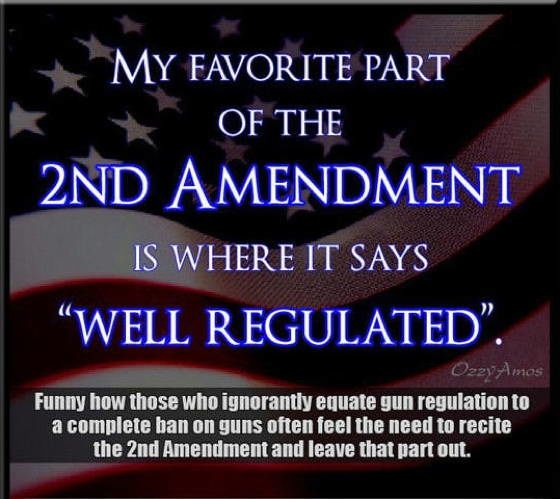
The Second Amendment was written with a defense for its own declaration of a right. In that sense, yes. It is "different."
However, a defense doesn't have to be the only defense. It was a sufficient defense for the justification of declaring the bearing of arms as a right.
As for your effort to suggest that the first portion of the statement is necessarily a modifying element, you're treating it as though it was an if/then statement, and on top of that, you're affirming the consequent.
Ex: "The weather having been rainy, the sidewalk is wet."
The latter is not logically contingent on the former. The sidewalk might have been wet because your neighbor Chuck's sprinkler system made it wet.
As long as it's rainy, the rain is sufficient for explaining why the sidewalk is wet, and so no additional explanation is necessary for the wet sidewalk, but the sidewalk being wet is not contingent on whether or not it rained.
What do the drafters of the Bill of Rights mean by "rights?"
You're suggesting that they mean the same thing ... except one place, where you don't like what that would mean. For that one place, they just must have meant something different. Even though they were drafting the "Bill of Rights," and the function for doing so was to outline the "rights" that were not to be infringed, they were probably not serious about that one, right?
But by all means, keep trying to push that square peg through. You've shown an exceptional amount of persistence, continuing steadfastly in your intellectual retardation.
Almost all the state bill of rights or declarations of rights written before the US Bill of Rights mention the need for a militia, most mention the right to bear arms tied directly to the Militia. None mention the right of self defense as the only or main reason to allow gun ownership. Two use both self defense and the need for a militia as reasons for the right to bear arms.
“SEC. 15. Every citizen has a right to bear arms in defense of himself and the state.” Conn
“XIII. That the people have a right to bear arms for the defence of themselves and the state; and as standing armies in the time of peace are dangerous to liberty, they ought not to be kept up; And that the military should be kept under strict subordination to, and governed by, the civil power.” PA
So if the Founders wished to use the “defense” of self protection as a reason for the right to bear arms, they had two examples. They did not. Their only stated reason for granting the right to bear arms was the need for a militia. The state documents repeatedly support that position. Every clause or section dealing with the right to bear arms ties the right to the militia and defense of the state. The Founders purpose in the Amendment as can be told by its structure was to provide for an armed force for national defense so that they would not have to rely on a large standing army which they consider a threat to their liberties.
You can sell the gun nuts prevalent at this site your bs but the original intent of the Founders is obvious. The right to bear arms is tied to the need for a government regulated militia.



 Lucy Richards, 57, charged with threatening a parent of one of the children killed in the 2012 massacre at Sandy Hook Elementary School in Sandy Hook, Connecticut, is shown in this booking photo in Fort Lauderdale, Florida