

Micheal Phelps?
Agree?
| 1 | 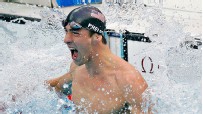 Michael Phelps Michael PhelpsSwim eight events, win all of them. OK, fine. Everyone knew eight gold medals was impossible -- so many things can go wrong in an Olympic swim meet -- yet everyone was equally sure Phelps could do it. Under enormous pressure brought on by his once-in-a-generation talent, Phelps easily could have buckled under expectations at the 2008 Beijing Olympics. But Phelps never blinked in his quest to top Mark Spitz, and his voyage became a nightly TV soap opera for Americans. And Phelps, a monumental athlete, was up to the task. |
| 2 | 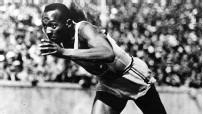 Jesse Owens Jesse OwensHere was a hero, an athlete so great even the German propagandists made him the star of their films about the 1936 Berlin Olympics, where Owens took golds in the 100 meters, 200 meters, 400 relay and long jump. Owens was an athlete so far ahead of his time that his long jump record from 1936 stood for nearly a quarter-century. To this day, he remains a barrier-breaking standard bearer for what the Games can show the world. |
| 3 | Carl Lewis It is possible for a man to live up to great expectations, and still be underappreciated. Lewis is such a man. He matched Jesse Owens in 1984, which was no surprise. He was King Carl, and the whole world expected him to win the 100, 200, long jump and 400 relay. What was surprising was his staying power. He burst onto the scene after making the Olympic team in 1980 and refused to go away until 1996, when he won his fourth gold in the long jump, his ninth gold overall. The King had given all he had, which was a lot. |
| 4 | Mark Spitz The brash Californian predicted he would win six swimming gold medals in Mexico City. But he won just two relay golds in 1968. But Spitz rebounded in Munich with a mustache for the ages and a performance to match: seven events, seven gold medals. His career medal total of nine golds is tied for second on the all-time list; seven golds in one Games has only been exceeded by one man, some guy named Michael Phelps. |
| 5 | Michael Johnson Things human beings weren't supposed to be able to do: win the 200 and 400 in the same Olympics and hold world records in those events simultaneously; run fast with a low knee lift and an upper-body position that resembled someone in the Milwaukee Brewers' sausage race. Johnson did all these things on his way to four gold medals, three in the 1996 Games, becoming the dominant sprinter of the 1990s and setting a 400 world mark (43.18) in 1999 that no one has approached. |
| 6 | Wilma Rudolph Want a revelation? Hunt around the web for old clips of Rudolph at the 1960 Olympics. What you'll see, especially in her smashing 200 victory, is the same feeling inspired by Usain Bolt in 2008 -- a runner pushing boundaries of possibility. Rudolph, who overcame complications from polio, did that her whole life, winning 100, 200 and 4x100 relay golds in Rome, then insisting on an integrated victory ceremony when she came home to Tennessee. Revelatory. |
| 7 |  Jim Thorpe Jim ThorpeThe Games' decathlon turns 100 this year, and with it the Olympic legend of Thorpe. The American won gold in the since-discontinued pentathlon and decathlon at the 1912 Stockholm Games, setting records that held up for decades. His victory also spawned a story that resonated: When told by Sweden's King Gustav V, "You are the greatest athlete in the world," Thorpe supposedly replied, "Thanks, King." |
| 8 | Greg Louganis The DiMaggio of Diving, Louganis' athletic yet seemingly effortless style on the platform and springboard netted him five medals from 1976-88, four of them gold. He would have likely earned another two titles in Moscow had the U.S. competed. The obstacles he overcame to achieve that success, including an abusive childhood and HIV diagnosis before the 1988 Games, make his triumphs even more laudable. |
| 9 | Jackie Joyner-Kersee Joyner-Kersee may be the best female athlete ever for her work on UCLA's hoops team, as well as in track. But she's best known for the Games. She won silver in the heptathlon at the 1984 L.A. Olympics, then gold in the same event in the next two Olympics. The 1988 Seoul Games marked the pinnacle of her career; she won one of her many duels against East Germany's Heike Drechsler to win the long jump, then set a world heptathlon record that stands to this day. |
| 10 | Natalie Coughlin With a medal in the 4x100-meter freestyle relay in London, the 29-year-old Coughlin can tie Jenny Thompson and Dara Torres for most medals by a female U.S. Olympian with 12. But Coughlin's numbers are already more significant. She has medaled in every single Olympic event she has entered, her back-to-back 100 backstroke golds are unprecedented and she has five individual medals. |








 U.S. Summer Olympians


