jmog;1573826 wrote:His label, while not PC, has merit to it.
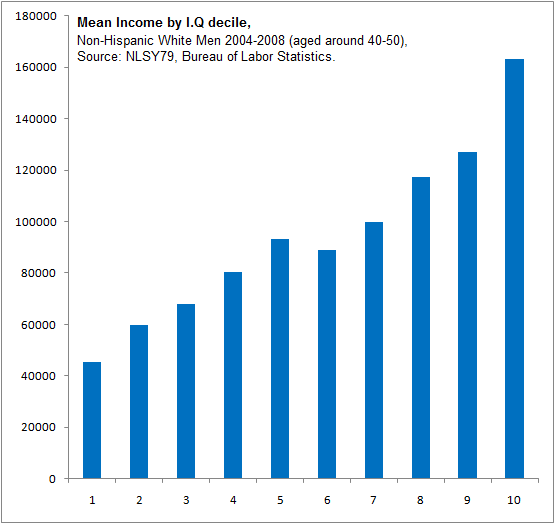
On average, the smarter people are, the more money they make. It is a direct, linear relationship.
and why does this happen
In examining the opportunity gap between high- and low-income children, it is important to begin at the beginning— birth. The evidence suggests that children of high- and low-income families start out with similar abilities but rapidly diverge in outcomes.
At the earliest ages, there is almost no difference in cognitive ability between high- and low-income individuals. Figure 4 shows the impact of a family’s socioeconomic status—a combination of income, education, and occupation—on the cognitive ability of infants between eight and twelve months of age, as measured in the Early Childhood Longitudinal Survey. Although it is obviously difficult to measure the cognitive ability of infants, this ECLS metric has been shown to be modestly predictive of IQ at age five (Fryer and Levitt 2013).
Controlling for age, number of siblings, race, and other environmental factors, the effects of socioeconomic status are small and statistically insignificant. A child born into a family in the highest socioeconomic quintile, for example, can expect to score only 0.02 standard deviations higher on a test of cognitive ability than an average child, while one born into a family in the lowest socioeconomic quintile can expect to score about 0.03 standard deviations lower—hardly a measurable difference and statistically insignificant. By contrast, other factors, such as age, gender, and birth order, have a greater impact on abilities at the earliest stages of life.
Despite similar starting points, by age four, children in the highest income quintile score, on average, in the 69th percentile on tests of literacy and mathematics, while children in the lowest income quintile score in the 34th and 32nd percentile, respectively (Waldfogel and Washbrook 2011). Research suggests that these differences arise largely due to factors related to a child’s home environment and family’s socioeconomic status (Fryer and Levitt 2004).
http://www.brookings.edu/research/re...gher-education