HitsRus;453688 wrote:It is not a matter of whether I think it is wrong, as much as I'm not naive enough to believe that a man will not act in self interest....no matter how much he makes. If it were a matter of society"asking", and people paying taxes, we wouldn't need the IRS would we? We wouldn't need to make your employer an unpaid tax collector who garnishes a portion of your wages to feed the bloated spending in Washington. LOL...
"The government suggests that at your income level, you donate "$X.00" to the Treasury." I'm sure ALL but the top 2% would pay their suggested share...because they are 'good' people...and the top 2% are bad.....
I'm just trying to keep it real here. There is no business or employer that is not going to pass a tax on at the expense of his bottom line. To make tax policy on the assumption of something different, or on the basis of some elitist fantasy is ludicrous.
The business owner raising prices in response to a tax increase is contradictory to his willful consent (through his elected representatives) to offer more of his profits to the state. Back to the days of Aristotle he wrote about how every state has goals and ends some of which may be good or bad. A person can be both a good person and a bad citizen or a bad person and a good citizen. Take Nazi Germany for example; a good citizen was complicit in exterminating the jews but general notions of morality would suggest that this person was a "bad person."
Evolutionary psychology will tell you that self-interest is indeed the general rule and yet, a man passing tax onto his customers, therefore passing a harm onto others violates all kinds of notions of popular morality from christian morality to deonotological ethics and even utilitarianism. Not only does it seem contrary to various moral philosophies; it also reflects poorly on this person's citizenship. If he were a "good" citizen, he would gladly adhere to the will of the majority when that will did not violate rights prescribed in the social contract to which he is privy.
As to the "donation of tax." This is commonly used as an argument that the government forcefully takes your property. Obviously, if there were no witholding mechanism, the government would not receive the taxes it is owed under the laws developed by the will of the people collectively from not only the top 2%, as evidenced by the fact that sole proprietors are the largest group responsible for under-reporting their income. This I don't see how is relevant to the discussion. But nonetheless, the gubment has a future interest in money owed as tax the second it is passed and therefore it becomes, not only the taxpayer's property but the governments...(fwiw I do think it would be a worthy reform to allow for businesses to receive compensation for the service of tax collector (which would also be taxed following s61 of the IRC) and that interest should accrue on overpayments of tax due back to the taxpayer).
In the 80's, The University of Chicago school of thought got into everything and society was told that by cutting taxes lower than ever before, these good citizens at the very top would hire more and increase wages and redistribute their new found wealth from being relieved of tax burdens down through their would be employees; this was their civic duty as part of this new economic strategy. As people, could they individually avoid this mandate and hoard it all to themselves as free individuals in a capitalistic society? Sure, but are they good citizens then? It seems to me that the answer is no.
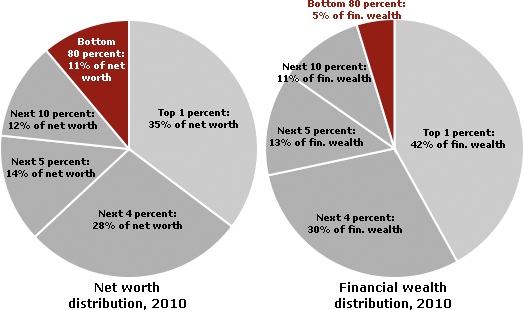
The small business man who passes a tax onto his consumers is the same as the top 2% guy; perhaps not a good citizen...but his economic impact is nowhere near the same as the truly elite in the very top...the very top who have seen extraordinary increases in income since 1990 where as the rest of us have stagnated.
You say, "there's no business that's going to pass on a tax at the expense of the bottom line." But that is to say that morality cannot be taught and that business schools cannot repudiate strict shareholder theories of the firm in favor of other's; that a history of political thought and an understanding that we're a united republic founded on Lockean and Hobbesian principles cannot be the foundation for which a business incorporated under the laws of one of our sovereign states?
But alas, even if we're to throw naivety out the window and just accept that our employers and the large companies who's products we consume will pass all of their societal responsibilities and burdens (of which we already have our own) onto us....where is your anger? Why are you not angry that they are passing the buck onto us?
There is plenty of anger around here for the lazy, non-self-reliant, bums who pass their societal burdens onto us but what about those perfectly well off...self-reliant and autonomous; who also pass that burden onto us? You just accept it as "acting in self-interest." Why not also accept a welfare queen spitting out babies and getting them on SSI as "acting in self-interest." You don't. You have a moral disdain for this person; yet the man at Wal-mart who raises the price of your food even after he's consented through representative democracy to absorb the cost of paying for healthcare for his millions of employees.
And yes, the issue of "consent" through a representative democracy as our founders envisioned is a fuzzy one...but it is nonetheless the root of our Republic and John Locke tells us that we have the right to revolution against it. Nonetheless, our people, many of which are still alive, have consented to tax rates as high as 98% and as high as 60% in the early 80's in order to pay for things willed by our federal majority. Certainly if those were thought justified, 39.6% is no time for revolution.
In grade school we learn about the virtues of being a citizen before we consent to the laws of that state and become a full citizen at the time of being able to vote...we say the pledge of allegiance to that state daily...."I pledge allegiance to the Flag of the United States of American and to the Republic for which it stands one nation, under God, indivisible, with liberty and justice for all."
It is an oath of loyalty to the democratic will that forms the laws of that republic; an oath to be a good citizen and loyal to the stars and stripes (perhaps even if it means being a bad person? In which case a moral dilemma would arise....but I digress).
It seems that for you, the oath of citizenship is meaningless. Why should we expect our businesses to keep in mind their allegiance to our nation? Why should we expect those benefitting greatly from our demand and consumption and the regulated capitalistic system forged by us and the impenetrable military force that protects their substantial property, lives and liberty?
Maybe it's true...maybe we're all lost causes....maybe ethical egoism always trumps the conflicting duty of being a good citizen; but in a world knowing that we're all intertwined...;doesn't this unsettle you at all?
Again, the raped defending the rapist...surely, it's in the rapists interest to rape if his victim not only will let him get away with it but preach to the world as to why it's justified. Hoodwinked.